
James "Jim" McWilliam is remembered as a scientist of vision and energy who left a global legacy in agricultural research.
Jim McWilliam was a pioneering agricultural scientist and the first Director of the Australian Centre for International Agricultural Research (1982–89), where he built lasting partnerships between Australian researchers and developing countries.
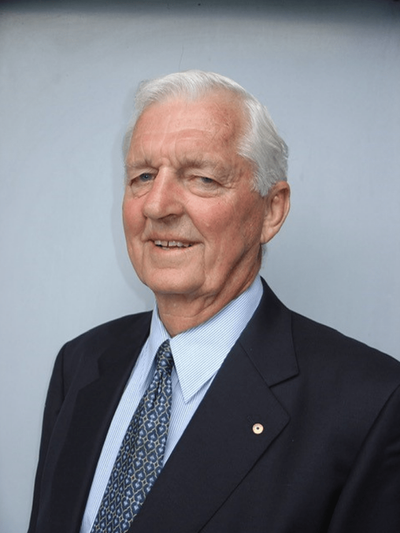
Born near Leyburn, Queensland, Jim studied forestry at the University of Queensland and in the US, completing a PhD at Yale. He worked with the Queensland Forestry Service, CSIRO and later as Professor of Agronomy at the University of New England, publishing widely and mentoring many postgraduate students.
Jim was a Fellow of both the Australian Institute of Agricultural Science and the Academy of Technological Sciences and Engineering, and in 1989 was made an Officer of the Order of Australia (AO).
He established its enduring culture, internal processes and global reputation. He also served on the Boards of Management of six international agricultural research centres:
- International Center for Agricultural Research in the Dry Areas (ICARDA 1976-81)
- International Wheat and Maize Research Center (CIMMYT 1983-87)
- International Food Policy Research Institute (IFPRI 1984-89)
- International Center for Research on Agro-Forestry (ICRAF 1989-94)
- International Rice Research Institute (IRRI 1990-95)
- Asian Vegetable Research and Development Center (AVRDC, now the World Vegetable Center 1990-95).
Jim was also a key figure in the Crawford Fund. He made numerous contributions to its training programs and served on its Queensland Committee from its inception in 1996 until 2006. This included acting briefly as its Coordinator in 2005-06 when the then Coordinator, John Vercoe, died in office.
With Jim’s death, Australia has lost a transformative leader and a foundational global figure in agricultural research for development. He was, for a generation, a charismatic Australian champion of international agricultural research (IAR). However, in the rush to acknowledge his contribution to IAR, we should remember that first and foremost, he was a scientist of rare quality. Jim was born in Toowoomba, Queensland, Australia. His parents raised sheep and cattle on a property near Leyburn on Queensland’s Southern Downs.
At an early age he was sent as a boarder to Toowoomba Grammar Preparatory School (“Toowoomba Prepâ€�) and later attended СÖíÊÓƵ (1942-45). He obtained a Queensland Forestry Cadetship to study forestry at the University of Queensland and the Australian Forestry School in Canberra, and graduated with a BSc (For) (Hons) degree and a Diploma in Forestry.
In 1951 he became the first geneticist in the Queensland Forest Service. Based at Beerwah, SE Queensland he joined a small tree breeding group working on Pinus and Auricaria species, notably slash pine (P. elliotti). In early 1953 Jim was awarded a Rotary International Fellowship and a Fulbright Fellowship to study at Duke University, North Carolina, USA where he graduated with a Master’s degree in Forestry (MF) in 1954. He was then still with the Queensland Forestry Service, and at their request he made a trip through British Honduras and the Republic of Honduras to examine the natural stands of Caribbean pine (P. caribaea). Gary Bacon (former CEO of Queensland Forestry) recently noted that Jim’s favourable report resulted in increased plantings of this tropical pine in Queensland, and after crossing with slash pine the F1 hybrid became a favoured plantation species; only slash pine is planted on a larger area in Queensland. In 1955 Jim obtained a Research Fellowship to attend Yale University where he completed a PhD in 1958.
In his years as a production forestry researcher Jim was author or co-author of about a dozen scientific publications on aspects of tree breeding including seed production, pollen physiology and dispersal, and barriers to hybridisation among Pinusspecies. By the time he returned to Australia in 1958 he was already an established scientist. In 1958 Jim obtained a research scientist position in CSIRO’s Division of Plant Industry in Canberra, and for the next 13 years he worked on the genetics, physiology and breeding of the temperate/Mediterranean grass phalaris (Phalaris aquatica). CSIRO had commenced a breeding program in the late 1950s which it was to maintain for about 50 years. The program quickly grew to half a dozen scientists including four plant breeders and attracted other researchers from within CSIRO and around the world.
Jim thrived in this environment of creative energy, contributing about 30 scientific publications and several cultivars. His research was innovative, effective and always relevant to the task. Time was not wasted; when he got an idea, he moved quickly to implement it. He had an ability to design and bring together a number of complementary experiments to address a problem. When his own wide-ranging research skills needed boosting, his charismatic personality enabled him to attract collaborators. People wanted to work with him.
In 1971 Jim became Professor of Agronomy at the University of New England (UNE), Armidale NSW. He remained there for 11 years. He transferred his personal phalaris research to Armidale, and in 1982 his final cultivar Uneta was released. However, the new position enabled him to extend his research to a wide range of crops and farming systems. He introduced the discipline of crop modelling and systems research. He supervised in full or in part 16 postgraduate students. His research with them reflected to a considerable extent their personal interests and the requirements of research funding bodies, but sunflowers (Helianthus annuus) became a common focus and, mostly with students, he published about a dozen papers on aspects of sunflower physiology, growth and yield.
During his years at UNE, Jim became involved in various consultancy roles. Alec Lazenby, who was Vice-Chancellor of UNE at the time, recalls that Jim caught the attention of Sir John Crawford, who approached Jim to undertake a review of agricultural research in South America. When Jim protested that he had already used up his entitlements for leave of absence, Sir John – ever aware of protocol – replied that he had already obtained the Vice-Chancellor’s blessing. Years later, Jim told Alec that he believed Sir John was “testing him out�.
In 1982, when ACIAR was being established Sir John personally oversaw the recruitment of Jim as its first Director. Sir John chaired ACIAR’s first Board of Management. He kept clear of management decisions but urged Jim to move quickly; to get top-quality, well-known Australian scientists involved in the research, establish a favourable image and get some early “runs on the board� in terms of research outcomes.
Jim had a large network within the Australian research community, particularly within CSIRO, and he found it easy to attract top-quality researchers to work with ACIAR. He set up the partnership model through which researchers in Australia and developing countries designed the research together and shared the benefits. In a far-sighted move he established an impact assessment capability within ACIAR that tracked the outcomes of the Centre’s research projects. Many of the operational arrangements established by Jim continue to this day, and many of the fields of particular Australian research strength he identified remain in demand.
Arthur Blewitt, who was ACIAR’s Centre Secretary for most of Jim’s term as Director and travelled extensively with him remembers his commanding presence. When Jim spoke, people listened. Jim retired from ACIAR in 1989 and became a consultant in research management in CSIRO. For a year or two he continued to provide input to CGIAR Centre reviews and internal CGIAR processes. From 1991-94 he was Chairman of the Grape and Wine Research and Development Corporation. His membership of the Boards of ICRAF, IRRI and AVRDC continued until the mid-1990s. He established a personal consulting company. His decade of contributions to the Crawford Fund then commenced, particularly through his membership of the Queensland Committee.
Jim received numerous awards. He was a Fellow of the Australian Institute of Agricultural Science (FAIAS) and of the Australian Academy of Technological Sciences and Engineering (FTSE). In 1989 he was made an Officer in the Order of Australia (AO). In 2003 he received the CM Donald Medal – the most prestigious Australian award in agronomy.
Provided by daughter, Kate Rickards
Latest Blog
Study Skills Program
Just as teachers benefit from an understanding of the Learning Sciences in their lesson planning and preparation, so to do students when they are studying for major summative assessments. A survey of TGS students in Years 9 to 12 found that 70% of our boys felt that they knew how to study, with the biggest impediments to study being lack of motivation and too many distractions. The most highly preferred study technique was found to be rewriting notes. Cramming, rereading the text and rewriting…
Developing Teachers Worldwide
I recently had the pleasure of attending the 2023 International Boys’ Schools Coalition (IBSC) Annual Conference at Westlake Boys High School in Auckland, New Zealand, in my capacity as a Team Leader in the IBSC Action Research Program. Action research is a systematic inquiry conducted by teachers in their own classroom to better understand the impact that an aspect of their practice is having on their students. Each year, 40 teachers from IBSC member schools from around the world are accepted…
Developing a Sense of Belonging for our TGS Boarders
How do we adequately develop a teenager’s 'sense of belonging' in boarding? Head of Boyce House, Boarding, Mr Michael Hall has investigated how 'Maslow's Hierarchy of Needs' applies to boarding. It is a psychological theory that suggests human beings have a set of fundamental needs that must be fulfilled in a hierarchical order. The theory proposes that individuals must first satisfy their physiological needs before moving on to higher-level needs, such as the 'belongingness' that is so…
Kia Moemoe� – Dream Beyond Limits
A 12-year study has found that boys consistently perform better in an all boys’ school compared to boys in co-educational schools. This was one of several interesting topics presented at the recent International Boys’ Schools Coalition (IBSC) Conference in Auckland, New Zealand which I attended alongside three of my СÖíÊÓƵ colleagues – Mr Luke Rawle, Mr Dave Klan and Mrs Jessica Galbraith. We joined 600 leading educators from 15 countries around the world for the four-day…
Blue and Gold in the Blood
“I had such fond memories from the School and enjoyed all the opportunities available, particularly participating in sport and learning at such a high level; my sons were going to have the same great education,� said Chris adamantly. Chris was a boarder from Dalby and an “all-rounder� as a student. He was part of the 1st XV, a CUO in the Cadets, a member of the debating team, involved in drama (featuring in two plays during his time) and a good academic student. “I really enjoyed boarding,�…
The Benefits of Repeated Reading
An effective and evidence-based method that can significantly improve your child's reading abilities is repeated reading. Reading proficiency is a vital skill that sets the foundation for academic success and lifelong learning. Repeated reading, a simple yet powerful technique, has been proven to enhance reading fluency, comprehension, and overall confidence. Let's delve into why repeated reading is such a beneficial practice for your child. Research consistently supports the benefits of…
Print v Digital
I recently read an article by Petra Stock, entitled "Streaming Stories: Will Children’s Digital Book Platforms Upend Print", an interesting discussion comparing ebooks and print media and the ways they are being used during and post COVID. Which is better according to the article? Well, there is a clear winner; however, like many things, the answer can depend on the situation. I'd like to break elements of the article down, along with my own thoughts and compare the two. Social…
Striking a Balance
We understand that, as parents, we aspire to provide our children with the best education and opportunities for growth. Within the Junior School at СÖíÊÓƵ, we believe in fostering a love for learning while enabling your son to reach his full potential. In this article, we would like to emphasise the significance of automaticity and basic skill practice in extending your child's learning journey, while emphasising the importance of respecting their individual pace. Automaticity…
Developing Sportsmanship from Prep
Overwhelming pride in wearing the Blue and Gold is a familiar emotion for СÖíÊÓƵ students, as is abundantly evident in all our boys, from Prep to Year 12. This emotion and passion for the School is the essence of our TGS culture and defines what it means to be a TGS student. The launch of the 2022 - 2026 Strategic Plan creates an exciting opportunity for our co-curricular program, which links perfectly into the "character and wellbeing" pillar. The development of good…


