“Deep Time History of Australia is a new unit that will be mandatory for all schools in Australia to implement by 2026. TGS's Humanities Department has implemented the unit ahead of time with a local focus for both content and associated assessment.�— Mr Douglas Michael, Teacher of History and Philosophy & Reasoning

On Tuesday, 27 February and again on Monday, 19 August, our Year 7 History students had the privilege of visiting Western Wakka Wakka cultural heritage site, Gummingurru, as part of their study of the Deep Time History of Australia.
Gummingurru is unique in being the best-preserved initiation site in southeast Queensland, including bora rings and various stone arrangements that have ancient links to the totems and kinship practices of the Jarowair and Giabal people of Toowoomba and the Darling Downs, as well as the broader region within the highly significant cultural landscape of the Bunya Mountains.
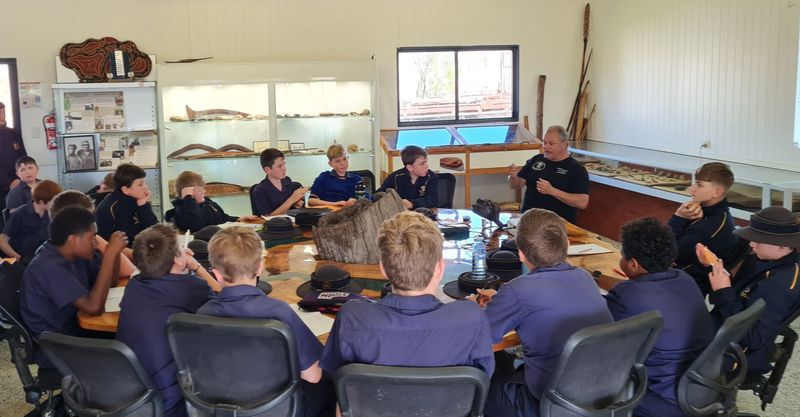
The boys were welcomed to, and guided through, the site and its learning centre by Mr Shannon Bauwens, a Western Wakka Wakka man, traditional custodian of Gummingurru, and board member of the Bunya Peoples Aboriginal Corporation. The boys partook in a smoking ceremony to cleanse themselves on arrival before gaining insight to Shannon’s encyclopaedic knowledge of the site’s history and cultural practices of the Indigenous peoples of the region. The boys who visited last Monday are now busy consolidating their knowledge in an assessment piece based on their visit. I have asked some of the Year 7s to share their learnings about the historical significance, changes and continuities associated with Gummingurru.
Our aim in localising the content is to have a more meaningful impact on students and how the entire unit is delivered and with significant sites like Gummingurra so close to our School it only serves to enrich the learning experience.
How ancient is the site at Gummingurru and how long was it used? The Gummingurru site is predicted to be around 4000 to 6000 years old and was a site for many purposes. The site was used for a long time before initiation was stopped in the 1890s. This site is still visited by the public but only to have a look around and to learn about the site’s history and cultural background.Â
Who went to Gummingurru and how far did they travel? Many tribes travelled to Gummingurru for initiation ceremonies and other ceremonies. The tribes travelled from as far west as Cunnamulla and Charleville, the Clarence River in Northern NSW, and Bundaberg/Dawson River to the North. This is about a six-hour drive in a car and would be months on foot. They travelled along songlines linking the places together. After initiation they travelled to the Bunya Mountains for the Bunya Festival, Bunya nut feasts and associated ceremonies.
What was Gummingurru used for? The Western Wakka Wakka cultural heritage site known as Gummingurru was used as an initiation site of young men. Initiation was where the kippas (young men) would be put through the law regarding their assigned yuree (totem) in initiation ceremonies. Kippas who participated in these were chosen by the elders based on whether the kippas were mature enough. This would mean kippas would have the chance of becoming a man, which meant being granted status, rights to participate in ceremony and ritual and education.
What was the first order of business for the men of Gummingurru? The men of Gummingurru would be initiated by the elders which allowed them to enjoy increased status and the right to be educated about their role and responsibility to protect their yuree ‘totem’, which might have been an animal like the emu or carpet snake. The men who went through ceremony at Gummingurru placed rocks in the shapes of their totems to honour them. The men of Gummingurru and their families would then travel the massive ceremonies in the Bunya Mountains. The Bunya ceremonies were hosted to trade Bunya nuts, dance, hold ceremony, arrange marriages and settle arguments. After being assigned their totem, it then became their job to protect the animal and its habitat or country, e.g. Emu Country.
What happens at Gummingurru now and how are traditional practices being revived? On our trip to Gummingurru and Cobb & Co we learned that the site is used for teaching our generation the significance of First Nations heritage and history. The ancient custodians of the land such as Wakka Wakka, Gaibal and Jarowair people used cultural burning to keep the Gumminguru site safe and less likely to experience severe bushfire. Modern custodians, such as the Bunya Peoples Aboriginal Corporation manage country the same way today. This form of burning is being revived to care for yurees, such as a turtle, emu and dingo and their connected country in an ongoing way for the current and future generations.
Do you think there are similarities between Gummingurru and TGS as ‘man-making’ sites? During our tour of Gummingurru, traditional custodian, Shannon Bauwens, explained to us how Gummingurru was a learning place for young indigenous men, or a ‘man-making' site where young men were ‘made’ or transitioned into adult men through ceremony. A place where boys arrived but left as men. At Gummingurru young men were taught about socialisation and the values of their people to prepare them for adult life. I do think Gummingurru is similar to TGS, as these are the things we learn here in addition to obtaining an education. Many of us arrive at TGS as boys but will also leave as men.
Latest Blog
Echoes of Home: Boarding is who we are
It's there in the early mornings before the day has properly begun, in the noise of boys lining up in the dining hall and in the easy banter that carries them back from sport in the afternoon. Just as often, it shows up in the quieter moments, the ones that tend to go unnoticed at the time but, slowly and steadily, shape who they become. There's also a shared understanding that doesn't need much explaining. What good rainfall means after a long dry spell, or how strong cattle prices on a Friday…
Fiji Rugby Tour 2026: Lessons in Adaptability and Gratitude
Set against the stunning backdrop of Fiji, the tour, held from 3 to 10 April 2026, blended high-level competition, cultural immersion and unexpected challenges. Two demanding matches against local opposition tested adaptability and resilience, while a late-season Severe Tropical Cyclone Vaianu forced significant changes to plans and schedules. Throughout the disruption, the boys’ behaviour was exemplary, drawing praise from hosts and reinforcing the values at the heart of the program. Based in…
Musicians First, Teachers Always
When the lights came up on & Juliet at the Empire Theatre, more than 6,700 audience members were treated to a bold, high‑energy production backed by an extraordinary team of professional musicians. Among them were two familiar faces from СÖíÊÓƵ: Ms Teresa Brix and Mr Mark Chalmers. For the TGS community, their involvement in one of the region’s largest theatrical productions is something to celebrate, not simply as a professional achievement, but as a powerful reminder of…
Building Good Character
This commitment extends beyond the classroom into every aspect of School life, including programs that encourage our boys to reflect on who they are, how they treat others and the kind of men they hope to become. This week, students from Years 7 to 10 took part in two significant character and wellbeing programs delivered by Damon Joseph and Daniel Principe. Although different in design, both workshops reinforced the same message, that character is learned, practised and strengthened through…
Stateside Success: The Growing US College Pathway for TGS Boys
A Parent's Perspective: From Blue & Gold to Bowling Green For the TGS boys that take the trip to the United States, their pathways are diverse, but they share a common foundation: the support, discipline and belief built on the 52 acres that is our 150-year-old campus. For past TGS mum, Adele Spurgin, the journey from watching her boys run out in the blue and gold of СÖíÊÓƵ to seeing them play together in the orange and brown strip of Bowling Green State University’s…
Helping Boys Build Stronger Identities at TGS
Social media influencers, hyper‑masculine stereotypes and the pressure to “performâ€� academically, socially and emotionally can distort a young man’s sense of self long before he has the tools to understand what he’s feeling. СÖíÊÓƵ (TGS) has recognised this challenge and responded with intention. Through a bespoke Pastoral Care model and a powerful partnership with Tomorrow Man and other leading professionals, the School is reshaping how boys understand identity, connection…
Cambodia Cultural and Service Tour
Across twelve days with RAW Impact, the group moved through moments of cultural immersion, physical work, reflection and genuine connection with local communities. Their words capture the impact more powerfully than any adult could. Phnom Penh: Confronting history to understand the present The tour began in Phnom Penh, where the group visited the Killing Fields and S21 before beginning their service work. For many boys, this was the moment they realised the tour would be life changing. As Year…
Old Boy Geoffrey Smith inspires at our Senior School Speech Night
СÖíÊÓƵ’s Senior School Speech Night was marked by a powerful address from Old Boy Geoffrey Smith (2002–06), recently named the 2025 Australian of the Year for Queensland. Geoffrey, co-founder of Australian Spatial Analytics (ASA), has become a national leader in recognising the untapped potential of neurodivergent Australians in the workforce. His organisation provides geo-spatial and engineering services while creating meaningful employment opportunities - with 80 per cent…
Tears at the Gate, Pride at the Finish
Melanie Elms says she regularly sees a group of TGS parents socially, they've become lifelong friends Heartfelt moments bookend the boarding years “It feels very surreal. I'm proud, but it is very surreal.â€� Those were the words of Mrs Melanie Elms from 'Taringa' near Edgeroi, New South Wales, as she reflected on the moment her youngest son Sam finished his time at СÖíÊÓƵ. An end to walking up to Taylor House returning a boarder to TGS forever and it comes just 12 months after…


